
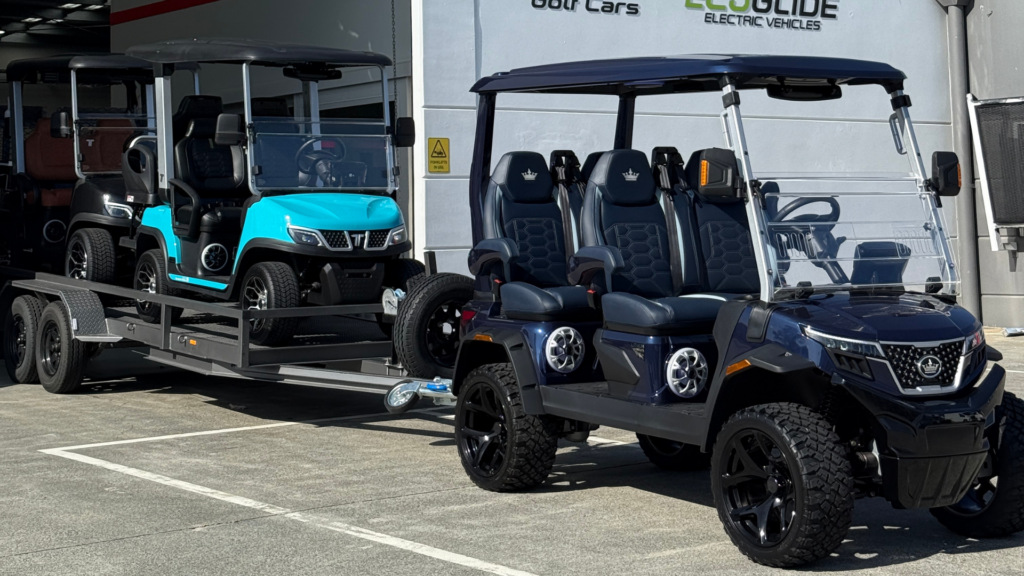
2WD vs 4WD Golf Carts: Which Is Right for Your Property?
Choosing between a two-wheel-drive and four-wheel-drive golf cart is not simply a matter of selecting the most powerful-looking vehicle.
The right drive system depends on where the cart will operate, the surfaces it will encounter, the number of passengers it needs to carry and how frequently additional traction will genuinely be required.
A two-wheel-drive golf cart will usually be suitable for smooth paths, maintained private roads, golf communities and relatively flat properties. A four-wheel-drive golf cart is worth considering when the vehicle will regularly travel across grass, gravel, inclines, loose surfaces or uneven private tracks.
Buying more capability than you need can add unnecessary size, weight and cost. Choosing too little capability can leave you with a cart that struggles to perform reliably in your operating environment.
This guide explains the differences between 2WD and 4WD golf carts and helps you decide which configuration is better suited to your property.
What Is the Difference Between 2WD and 4WD Golf Carts?
A two-wheel-drive golf cart delivers power through one axle, normally the rear wheels.
This configuration is commonly used for golf courses, resorts, residential communities and private properties with smooth, predictable surfaces.
A four-wheel-drive golf cart can deliver power to both the front and rear wheels. This provides additional traction when the cart encounters grass, gravel, inclines or uneven ground.
The main differences include:
| Consideration | 2WD Golf Cart | 4WD Golf Cart |
|---|---|---|
| Powered wheels | One axle | Front and rear axles when 4WD is engaged |
| Best surfaces | Smooth paths and maintained roads | Grass, gravel and mixed terrain |
| Ground clearance | Usually standard or road focused | Often lifted |
| Tyres | Road or turf focused | Usually all-terrain |
| Manoeuvrability | Generally lighter and more compact | Larger but often supported by power steering |
| Energy demand | Usually lower | Can be higher when 4WD is engaged |
| Purchase price | Generally lower | Generally higher |
| Best use | Everyday passenger transport | Mixed-terrain passenger transport |
The right option should be based on normal daily use rather than the most difficult patch of terrain the cart might encounter once or twice a year.
How Does an On-Demand 4WD Golf Cart Work?
An on-demand four-wheel-drive golf cart allows the driver to select the drive mode that suits the terrain.
For ordinary travel across smooth paths and maintained private roads, the cart can operate in two-wheel drive.
When the cart reaches grass, gravel, loose ground or an incline, the driver can engage four-wheel drive to provide additional traction through the front and rear wheels.
This gives owners the flexibility to use:
- 2WD for smooth everyday transport
- 4WD when additional traction is needed
The Evolution DMAX XT4 and XT6 use dual electric motors to provide selectable two-wheel-drive and four-wheel-drive operation.
Four-wheel drive should not be treated as permission to enter unsafe terrain. Surface stability, gradient, water, passenger load and vehicle clearance must still be considered.
When Is a 2WD Golf Cart the Better Choice?
A two-wheel-drive golf cart will be the better choice for many Australian buyers.
If most travel takes place across sealed private roads, concrete paths, maintained resort grounds or relatively flat properties, the additional cost and size of a four-wheel-drive system may not be necessary.
A 2WD golf cart may be suitable for:
- Golf communities
- Lifestyle villages
- Resorts with maintained pathways
- Gated residential communities
- Flat private properties
- Event venues
- Smooth internal roads
- General passenger transport
- Travelling between a home, clubhouse or community facility
Two-wheel-drive carts are generally lighter, simpler and more efficient for smooth-surface use.
Models such as the Evolution DMAX GT4 and GT6 provide road-focused passenger transport with lithium power, premium seating and modern technology without the lifted all-terrain setup of the XT range.
When Is a 4WD Golf Cart Worth It?
A four-wheel-drive golf cart is worth considering when mixed terrain is part of the cart’s regular operating environment.
This can include:
- Acreage properties
- Grass paddocks
- Gravel driveways
- Moderate inclines
- Uneven private tracks
- Rural accommodation properties
- Resorts with mixed surfaces
- Large private estates
- Properties that become slippery after rain
- Sites where additional ground clearance is required
The additional traction can make the cart more capable when travelling across surfaces where a standard two-wheel-drive vehicle may lose grip.
A four-wheel-drive golf cart may also provide greater confidence when carrying passengers across changing terrain.
However, 4WD does not automatically make a golf cart suitable for every hill, track or off-road environment. Golf carts have different dimensions, weight limits and capabilities from dedicated all-terrain vehicles.
Is 4WD Better on Hills?
Four-wheel drive can improve traction on suitable inclines by distributing power across the front and rear wheels.
This can reduce the likelihood of the powered wheels losing grip, particularly on grass, gravel or loose surfaces.
Hill performance will still depend on:
- The steepness of the incline
- Surface condition
- Passenger load
- Battery charge
- Motor performance
- Tyre condition and pressure
- Vehicle momentum
- Ground clearance
- Weather conditions
A 4WD cart may provide more traction, but it cannot overcome unsafe gradients, unstable surfaces or poor driving decisions.
If hills are a major part of the intended use, discuss the terrain with EcoGlide and arrange a suitable demonstration where practical.
Does 4WD Provide More Ground Clearance?
Four-wheel drive and ground clearance are separate features, although many 4WD golf carts also have a lifted design.
The Evolution DMAX XT4 and XT6 combine selectable 4WD with:
- A lifted stance
- Larger all-terrain wheels and tyres
- Increased clearance
- Electric power steering
- A terrain-focused vehicle design
Additional ground clearance can help when travelling over uneven surfaces where the chassis of a lower cart may be more likely to make contact with the ground.
A lifted cart will have different handling characteristics from a lower road-focused vehicle. Drivers should reduce speed around corners and adjust their driving according to the terrain, passenger load and conditions.
Are All-Terrain Tyres Important?
Tyres play a major role in how a golf cart performs across different surfaces.
Road-focused tyres generally provide a smoother and quieter ride across sealed paths and maintained roads.
All-terrain tyres use a more aggressive tread pattern intended to provide additional grip across grass, gravel and mixed surfaces.
The trade-off is that all-terrain tyres can create more rolling resistance and may not feel as smooth as road-focused tyres on sealed surfaces.
When selecting tyres, consider:
- The surface used most frequently
- Whether the cart will operate on turf
- Passenger comfort
- Noise
- Traction requirements
- Tyre replacement costs
- Ground clearance
- Expected driving range
A more aggressive tyre is not automatically better. It must suit the property and intended use.
2WD vs 4WD for Acreage Properties
Acreage is one of the clearest applications for a four-wheel-drive golf cart, but not every acreage property requires 4WD.
A 2WD cart may still be suitable if the property has:
- Maintained internal roads
- Flat ground
- Sealed or compacted paths
- Limited wet-weather use
- No significant inclines
A 4WD cart may be more appropriate if the property has:
- Regular travel across grass
- Gravel roads
- Sloping ground
- Uneven private tracks
- Loose surfaces
- Changing wet-weather conditions
Consider where the cart will travel every week, not just where you hope it might travel occasionally.
2WD vs 4WD for Resorts and Accommodation Properties
For resorts and accommodation providers, the decision should be based on the routes used to transport guests and staff.
A 2WD cart may be suitable for:
- Sealed resort roads
- Maintained pathways
- Flat accommodation precincts
- Short guest transfers
- Smooth daily routes
A 4WD cart may be more suitable for:
- Rural resorts
- Farm stays
- Nature retreats
- Properties with gravel roads
- Venues with grass parking or event areas
- Accommodation spread across uneven terrain
Passenger comfort, ease of entry, turning space, noise and charging facilities should be considered alongside traction.
2WD vs 4WD for Golf Communities
A road-focused two-wheel-drive cart is often the most suitable choice for golf communities with smooth private roads and maintained pathways.
These buyers may benefit more from:
- Comfortable seating
- Easy manoeuvrability
- Golf-bag storage
- All-weather protection
- Quiet operation
- Road-focused tyres
- Convenient charging
A 4WD cart may be worth considering when the surrounding property includes steep sections, gravel access roads or mixed private terrain beyond maintained community paths.
Neither configuration should be assumed to be legal for public-road use. Registration and road rules vary between Australian states, territories and local areas.
Four Seats or Six Seats?
EcoGlide offers both 2WD and 4WD DMAX models in four-seat and six-seat configurations.
| Model | Passenger Capacity | Drive System | Best Suited To |
|---|---|---|---|
| Evolution DMAX GT4 | Four passengers | 2WD | Smooth paths and smaller groups |
| Evolution DMAX GT6 | Six passengers | 2WD | Group transport on maintained surfaces |
| Evolution DMAX XT4 | Four passengers | Selectable 2WD and 4WD | Smaller groups across mixed terrain |
| Evolution DMAX XT6 | Six passengers | Selectable 2WD and 4WD | Larger groups across mixed terrain |
Choose four seats when manoeuvrability and a shorter vehicle are priorities.
Choose six seats when the cart will regularly transport family members, guests, residents or resort visitors in larger groups.
It is usually better to select the capacity you need regularly rather than purchasing a longer cart for occasional additional passengers.
Evolution DMAX GT4 vs XT4
The GT4 and XT4 both carry four passengers across two forward-facing seating rows.
The main difference is their intended operating environment.
Choose the Evolution DMAX GT4 when:
- Most travel occurs on smooth paths
- The property is relatively flat
- Road-focused tyres are preferred
- A lower vehicle configuration is suitable
- Additional off-road traction is not required
Choose the Evolution DMAX XT4 when:
- The property includes grass and gravel
- Selectable 4WD is required
- Additional ground clearance is useful
- The cart will regularly encounter mixed terrain
- A lifted all-terrain design is preferred
The XT4 is not automatically the better cart. It is the better cart when its additional capability matches the property.
Evolution DMAX GT6 vs XT6
The GT6 and XT6 both accommodate up to six passengers across three forward-facing seating rows.
The GT6 is intended primarily for smooth paths, maintained private roads, resorts and lifestyle communities.
The XT6 adds selectable 4WD, dual-motor performance, a lifted stance and all-terrain tyres for properties with mixed surfaces.
Choose the GT6 for smooth group transport.
Choose the XT6 when you need to transport the same number of passengers across grass, gravel, inclines or uneven private-property surfaces.
Can a 4WD Golf Cart Replace a Utility Vehicle?
A 4WD passenger golf cart and a utility vehicle serve different purposes.
The XT4 and XT6 are primarily designed for passenger transport across suitable mixed terrain.
If the vehicle will regularly carry tools, landscaping equipment, materials or substantial loads, a dedicated Evolution Utility Vehicle may be more appropriate.
EcoGlide offers:
The correct model depends on whether your priority is passenger transport, load carrying, towing or a combination of tasks.
Questions to Ask Before Choosing
Before selecting a 2WD or 4WD golf cart, ask:
- What surfaces will the cart travel across every day?
- Are the routes flat, sloping or uneven?
- Will the cart operate after rain?
- How many passengers will it normally carry?
- Is passenger comfort or cargo capacity more important?
- How far will it travel between charges?
- Is additional ground clearance required?
- Will golf bags or other accessories be carried?
- Are all-weather clears required?
- Is the cart intended for private-property or public-road use?
- What servicing support is available?
- Can the proposed model be tested in representative conditions?
These questions provide a more useful basis for choosing a cart than appearance alone.
Frequently Asked Questions
Is a 4WD golf cart better than a 2WD golf cart?
A 4WD cart provides additional traction across suitable mixed terrain, but it is not automatically better for every buyer.
A 2WD cart may be more practical and cost-effective for smooth paths, maintained roads and relatively flat properties.
Do I need a 4WD golf cart for acreage?
It depends on the property.
A 4WD cart may be worthwhile if you regularly travel across grass, gravel, inclines or uneven tracks. A 2WD cart may remain suitable if the property has maintained internal roads and relatively flat terrain.
Can a 2WD golf cart drive on grass?
A 2WD cart can travel on suitable maintained grass, subject to the surface, slope, moisture, tyres and vehicle load.
It may have less traction than a 4WD cart on wet, loose or sloping grass.
Can a 4WD golf cart drive off-road?
A 4WD golf cart can provide additional capability across suitable grass, gravel and mixed private terrain.
It is not a replacement for a dedicated all-terrain vehicle and should not be used on unsafe slopes, unstable surfaces, deep water or hazardous tracks.
Does 4WD reduce golf cart range?
Operating a second motor, travelling across difficult terrain and using larger all-terrain tyres can increase energy consumption.
The actual effect on range depends on how frequently 4WD is used and the operating conditions.
Which EcoGlide models have 4WD?
Can a golf cart be driven on public roads?
Road-use and registration requirements vary across Australia.
Headlights, indicators, mirrors and seatbelts do not automatically make a golf cart legal for public-road use. Check with the relevant transport authority and local council before purchasing a cart for this purpose.