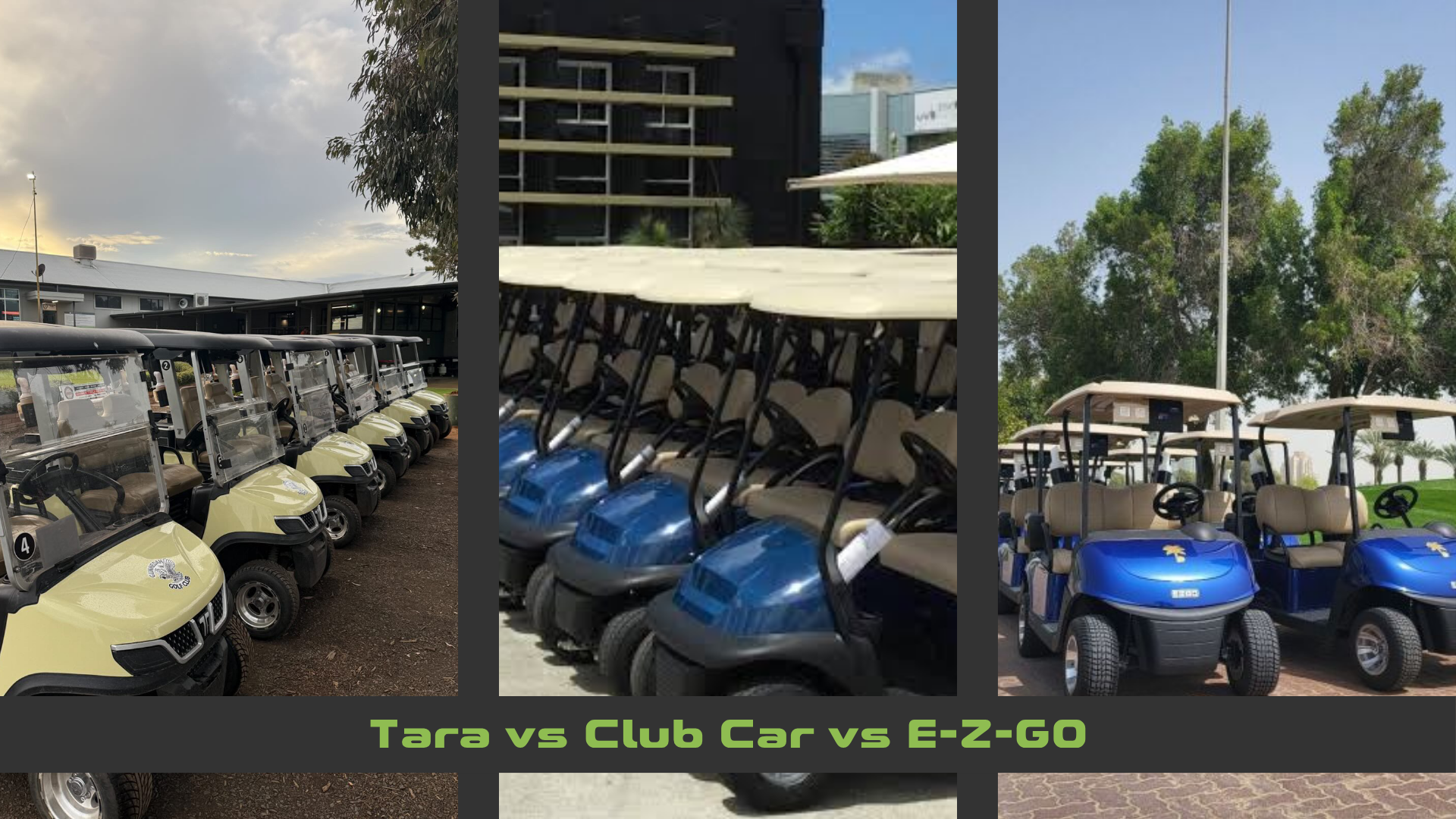
Are Chinese Golf Carts Good Enough for Australian Golf Courses? Tara vs Club Car and E‑Z‑GO
When an Australian golf course begins comparing a new cart fleet, the same names usually enter the conversation first: Club Car and E‑Z‑GO.
Both are established golf cart manufacturers with long histories, recognised products and strong positions within the global golf industry. It is understandable that club managers, boards and committees feel comfortable considering brands they have known for decades.
When a newer alternative such as Tara is introduced, one of the first questions is often:
“Why would we choose a Chinese-made golf cart instead of Club Car or E‑Z‑GO?”
It is a fair question, particularly when a golf course is making a significant investment in a fleet that may be used every day for several years.
But country of manufacture alone does not tell a golf course whether a fleet will be reliable, cost-effective or properly supported.
The more useful questions are:
- How was the cart designed?
- Is it purpose-built for golf course fleet use?
- What battery and electrical systems are included?
- How does it perform across the course?
- What warranty protection is provided?
- Are parts available in Australia?
- Who completes the servicing and warranty work?
- What happens when a cart is off the course?
- What is included in the quoted fleet price?
- What will the fleet cost to operate over its working life?
These are the questions Australian golf courses should be asking when comparing Tara, Club Car, E‑Z‑GO or any other fleet golf cart.
The Concern Is Not Really About China
When a golf club says it is concerned about a Chinese-made golf cart, the underlying concern is rarely the location of the factory itself.
The club is usually worried about:
- Build quality
- Product consistency
- Battery reliability
- Parts availability
- Warranty support
- Servicing delays
- Vehicle downtime
- Resale value
- Whether the supplier will still be available in several years
Those concerns are completely reasonable.
A golf course fleet is an operational asset. If carts are frequently unavailable, difficult to repair or unsupported locally, the effect can extend beyond maintenance expenses.
It can affect cart hire revenue, pace of play, member satisfaction, guest experience and the workload placed on golf operations staff.
That is why EcoGlide does not expect a golf course to choose Tara simply because the carts have an attractive purchase price or a long list of features.
The decision should be based on the complete fleet solution.
Manufacturing Location Is Only One Part of the Decision
Golf carts contain components sourced and manufactured through international supply chains. Batteries, controllers, chargers, electronics, body panels, wiring systems, tyres and accessories may come from different countries even when a brand is strongly associated with one particular market.
A cart should therefore be assessed on the quality of its engineering, components, assembly, testing, warranty and local support.
There are high-quality and low-quality products manufactured in every major manufacturing region.
The words “Chinese golf cart” describe where a vehicle may be manufactured. They do not, by themselves, tell a golf course:
- How the vehicle was engineered
- Which components were used
- What quality controls were followed
- Whether replacement parts are stocked
- How warranty claims are handled
- Whether trained technicians are available
- How the cart will perform on a particular course
The supplier and the support structure behind the fleet are just as important as the badge on the front.
Club Car and E‑Z‑GO Remain Important Fleet Benchmarks
A credible comparison should acknowledge that Club Car and E‑Z‑GO have earned their positions in the golf industry.
Club Car offers established Tempo fleet vehicles with lead-acid and lithium powertrain options, along with connected fleet-management technology.
E‑Z‑GO offers its RXV range with ELiTE lithium technology, fleet-management features and established golf course applications.
These are recognised products and should be included in a serious fleet comparison when they suit the club’s requirements.
EcoGlide is not suggesting that established brands are suddenly poor choices.
The question is whether Australian golf courses should automatically select a familiar brand without also assessing newer fleet alternatives.
More competition gives golf clubs the opportunity to compare:
- Upfront fleet pricing
- Standard equipment
- Lithium battery capacity
- Warranty coverage
- Passenger comfort
- On-course technology
- Servicing arrangements
- Parts availability
- Finance structures
- Expected operating costs
For many clubs, Tara deserves to be part of that evaluation.
Tara Is Designed for Golf Course Fleet Use
Tara’s Spirit range is not simply a lifestyle cart placed onto a golf course and described as a fleet vehicle.
The Tara Spirit Pro is designed for golf course use, with two-passenger seating, lithium power and practical equipment for regular player transport.
Depending on the selected fleet configuration, features can include:
- 48V lithium battery system
- Golf bag holders
- Rear storage basket
- Sand bottle holders
- Ball and tee storage
- Rain cover
- Sweater basket
- USB charging
- Touchscreen technology
- Comfortable seating
- Turf-conscious tyres
- Onboard charging
The purpose of these features is not simply to make the cart appear more impressive in a showroom. They are intended to improve the experience for golfers and make everyday fleet operation easier for the course.
Lithium Power Is No Longer the Difference on Its Own
Lithium batteries are an important part of a modern fleet decision, but Tara is not the only manufacturer offering lithium technology.
Club Car offers lithium options within its fleet range. E‑Z‑GO offers its ELiTE lithium system. Tara also uses lithium battery systems across its fleet models.
This means the comparison should go deeper than asking whether a cart has a lithium battery.
Golf courses should compare:
- Battery voltage and usable capacity
- Battery management system
- Charging time
- Charger type
- Expected fleet rotation
- Warranty duration and usage limits
- Replacement cost
- Diagnostic support
- Local availability of replacement batteries
- Performance under the course’s actual conditions
Lithium systems can reduce routine battery maintenance because they do not require the watering associated with traditional flooded lead-acid batteries. They can also provide consistent power and convenient charging.
However, the correct battery configuration still depends on the size of the course, terrain, cart utilisation, charging window and number of rounds played.
A flat 18-hole course and a high-volume 27 or 36-hole operation may have very different fleet requirements.
Warranty Must Be Read, Not Just Advertised
A large warranty number can look impressive, but golf course decision-makers should request the complete written warranty conditions before comparing proposals.
For eligible Tara Spirit Pro vehicles supplied by EcoGlide Australia, advertised warranty coverage includes:
- Eight-year lithium battery warranty
- Four-year motor, controller and charger warranty
- Two-year bumper-to-bumper warranty
The exact terms, exclusions, commercial-use conditions and claim procedures should be reviewed as part of the fleet proposal.
The same standard should apply to every competing brand.
Golf courses should ask:
- Is labour included?
- Are call-out costs included?
- Are there usage, energy or hour limits?
- Who determines whether a repair is covered?
- Where is warranty work completed?
- Who pays for transport if a cart must leave the course?
- Are replacement carts available?
- Are wear items excluded?
- Does the warranty change for fleet use?
- What maintenance records must the course retain?
A warranty is only valuable when the process behind it is clear and the supplier can respond when support is required.
Parts and Servicing Matter More Than the Logo
For a golf course, vehicle uptime matters more than brand recognition.
A well-known cart waiting several weeks for a component is still unavailable for hire. A competitively priced cart without local parts or technical support can create the same problem.
Before choosing any fleet, the club should assess the support provider as closely as the vehicle.
EcoGlide Australia provides fleet servicing and support from its Ormeau facility on the Gold Coast and works with golf courses across Queensland and Australia.
A fleet proposal should clearly explain:
- Scheduled servicing requirements
- Preventative maintenance
- Local technician availability
- Mobile servicing options
- Parts held in Australia
- Common repair turnaround times
- Warranty claim procedures
- Technical training
- Emergency support
- Replacement or loan-cart arrangements
This is where the importer, distributor and service team become critical.
The factory may build the cart, but the Australian supplier determines much of the ownership experience.
Compare Standard Equipment Carefully
Two fleet quotes can appear similar until the included equipment is examined line by line.
One proposal may include lithium batteries, chargers, rain covers, screens, storage baskets or course accessories as standard. Another may list several of these items as additional options.
Golf clubs should request a like-for-like comparison showing:
| Area | Questions to Ask |
|---|---|
| Fleet price | What is the total delivered and commissioned cost? |
| Battery | What battery is included and what warranty applies? |
| Charger | Is an onboard charger included with every cart? |
| Weather protection | Are windscreens and rain covers standard or optional? |
| Golf equipment | Are bag holders, baskets and sand bottles included? |
| Technology | Is the display standard and are ongoing subscriptions required? |
| Branding | Are course logos and fleet numbers included? |
| Delivery | Is freight, setup and staff handover included? |
| Servicing | What preventative maintenance is included? |
| Parts | Which commonly required parts are stocked locally? |
| Support | What response time applies when a cart is unavailable? |
The lowest advertised cart price is not necessarily the lowest fleet cost. Equally, the most familiar badge does not automatically provide the best value for every course.
Put the Cart on the Course Before Deciding
A fleet golf cart should not be assessed only through a brochure, specification sheet or showroom inspection.
Golf courses should test the cart under the conditions it will actually face.
A meaningful demonstration should include:
- Known hills and inclines
- Wet or soft sections
- Narrow paths
- Repeated stopping and starting
- Bag loading
- Two adult passengers
- Braking on slopes
- Turning in operational areas
- Comfort across rough sections
- Charging after realistic use
The club should involve the people who work with the fleet every day, including golf operations staff, greenkeeping staff, mechanics and management.
Feedback should be recorded rather than relying on a brief first impression.
Useful questions include:
- Was the cart comfortable over a full round?
- Did it maintain power on hills?
- Was braking smooth and predictable?
- Was the bag area easy to use?
- Did the tyres protect the playing surface?
- Were controls intuitive for golfers?
- Was cleaning and daily inspection straightforward?
- Could staff access key service areas easily?
- Did the battery complete the required rotation?
A controlled trial gives the committee evidence it can use.
Start With a Pilot Fleet if the Club Is Unsure
A golf course does not always need to replace an entire fleet in a single decision.
Where practical, a smaller pilot fleet can allow the club to assess Tara vehicles across a meaningful operating period.
The trial should monitor:
- Rounds completed
- Charging frequency
- Energy use
- Driver feedback
- Maintenance requirements
- Faults or warning messages
- Parts required
- Service response
- Cart availability
- Staff and member feedback
This turns a concern about manufacturing origin into a measurable operational assessment.
If the carts perform well and the support meets expectations, the club has real data to guide the next stage of its fleet decision.
Whole-of-Fleet Value Is More Important Than Purchase Price
Golf cart fleets should be evaluated using total cost of ownership rather than purchase price alone.
A whole-of-fleet assessment can include:
- Initial vehicle cost
- Freight and commissioning
- Charging infrastructure
- Electricity use
- Scheduled servicing
- Replacement parts
- Battery maintenance
- Battery replacement
- Technology subscriptions
- Vehicle downtime
- Residual value
- Warranty coverage
- Finance costs
- Expected service life
A higher purchase price may be justified when it produces better uptime, stronger support or lower operating expenses.
A lower purchase price may also produce excellent value when the vehicle, warranty and local support have been properly assessed.
The goal is not to find the cheapest cart. It is to identify the fleet solution that delivers dependable performance and the best operational value for the course.
Why Golf Courses Are Considering EcoGlide and Tara
Australian golf courses are considering EcoGlide because they want another serious option when comparing their next fleet.
The EcoGlide proposition includes:
- Purpose-built Tara fleet golf carts
- Lithium-powered configurations
- Competitive fleet packages
- Golf course demonstrations
- Australia-wide delivery
- Local servicing and technical support
- Warranty assistance
- Parts support
- Course branding and fleet setup
- Direct contact with an Australian team
- Help comparing vehicle and battery configurations
For golf clubs, the value is not simply that another cart brand has entered the market.
The value is having another supplier prepared to understand the course, recommend an appropriate configuration and remain involved after delivery.
Should a Golf Course Choose Tara Over Club Car or E‑Z‑GO?
There is no single answer that applies to every golf course.
Club Car, E‑Z‑GO and Tara offer different vehicles, technologies, warranty structures and commercial arrangements.
The right fleet depends on:
- Course size
- Terrain
- Number of holes
- Annual rounds
- Fleet rotation
- Charging window
- Member expectations
- Budget
- Required technology
- Servicing location
- Parts availability
- Long-term fleet strategy
Tara should not be selected simply because it may cost less than an established alternative.
It should be selected when the vehicle performs well on the course, the fleet package represents strong value, the warranty is suitable and EcoGlide can demonstrate reliable Australian support.
Likewise, Tara should not be excluded simply because it is manufactured in China.
A responsible fleet decision should be based on evidence.
A Better Question for Golf Course Committees
Instead of asking:
“Would we buy a Chinese golf cart?”
Ask:
“Does this fleet meet our operational requirements, provide suitable warranty protection and come with the parts and service support our course needs?”
That question produces a more useful comparison.
Country of manufacture can remain one consideration, but it should not replace proper due diligence.
The strongest fleet decision will come from comparing the carts on the course, reviewing the complete commercial proposal and understanding exactly who will support the vehicles after delivery.
Compare a Tara Fleet on Your Course
EcoGlide Australia works with golf courses to assess fleet requirements, compare configurations and arrange demonstrations of suitable Tara fleet vehicles.
Before recommending a fleet, our team can discuss:
- Course layout and terrain
- Current fleet challenges
- Daily cart demand
- Number of holes and rounds
- Charging facilities
- Lithium battery requirements
- Golf cart accessories
- Branding and fleet numbering
- Servicing expectations
- Delivery and rollout planning
If your golf course is comparing Tara with Club Car, E‑Z‑GO or another fleet provider, EcoGlide welcomes the opportunity to put the vehicle and support package through a proper evaluation.
Do not choose a fleet based on assumptions.
Test it. Compare it. Review the warranty. Meet the service team. Then make the decision that is right for your course.
Call EcoGlide Australia on 07 5654 8888 or visit our showroom at 95 Lahrs Road, Ormeau, Queensland 4208.
Frequently Asked Questions
Are Tara golf carts made in China?
Tara golf carts are manufactured in China and distributed in Australia through EcoGlide Australia. Golf courses should assess the vehicles using the same criteria applied to any fleet brand, including engineering, battery technology, course performance, warranty, parts availability and local service support.
Are Chinese golf carts reliable?
Reliability depends on the manufacturer, components, quality control, vehicle application and support network. It cannot be determined from country of manufacture alone. Golf courses should complete an on-course demonstration, review warranty terms and confirm how parts and servicing will be handled before purchasing.
How does Tara compare with Club Car?
Club Car is a long-established golf vehicle manufacturer with recognised fleet models and lithium options. Tara provides another lithium fleet alternative with modern equipment, competitive fleet configurations and support through EcoGlide Australia. The correct choice depends on course conditions, specifications, pricing, warranty and servicing requirements.
How does Tara compare with E‑Z‑GO?
E‑Z‑GO offers established fleet vehicles including its RXV ELiTE lithium range. Tara offers purpose-built lithium golf carts with fleet features and Australian support through EcoGlide. Golf courses should compare the vehicles on their own terrain and review the complete fleet proposal rather than comparing brand names alone.
Does the Tara Spirit Pro have a lithium battery?
Yes. The Tara Spirit Pro is available with a 48V lithium battery system designed for regular golf course use. The exact battery configuration should be confirmed in the fleet proposal.
What warranty is available with the Tara Spirit Pro?
Eligible Tara Spirit Pro vehicles supplied by EcoGlide Australia are advertised with an eight-year lithium battery warranty, four-year motor, controller and charger warranty and two-year bumper-to-bumper warranty. Complete warranty terms and commercial-use conditions should be reviewed before purchase.
Can EcoGlide arrange a fleet demonstration?
EcoGlide Australia can discuss demonstration options with golf courses considering a Tara fleet. The demonstration should be completed across representative areas of the course and under realistic passenger and operating conditions.
Does EcoGlide provide servicing after delivery?
EcoGlide provides servicing, parts and fleet support from its Ormeau facility on the Gold Coast, with support arrangements available for golf courses across Queensland and Australia. The appropriate servicing plan should be confirmed in the fleet proposal.
What should a golf course compare before replacing its fleet?
Golf courses should compare vehicle performance, battery configuration, included equipment, warranty terms, parts availability, servicing response, charging requirements, technology costs, fleet price and expected total cost of ownership.
Can a golf course trial a smaller number of carts first?
A pilot or staged fleet can be a useful way to evaluate performance, charging, maintenance and golfer feedback before committing to a larger rollout. Availability and commercial terms should be discussed with EcoGlide Australia.